By guest blogger Sue Croft
I saw a delightful patient today who came in full of apologies for not adhering to all the strategies we mapped out at our first meeting a month ago. Now I am totally understanding about time pressures, changes in circumstance, things that unexpectedly crop up to throw a spanner in the works of life. It happens many times to me and I totally get it. But when I questioned this patient more closely – these ‘spanners’ were of great significance. She had lost her darling Mum of 97, another friend from cancer and a younger woman was very ill with a serious cancer and the prognosis had just been spelt out leaving them all devastated.
It’s actually a wonder she could manage any of the strategies we had spoken about.
But in fact she had done her diary; she had started to do her pelvic floor muscle training; she had adopted the new position for voiding and defaecation and she had gone 100% decaf. So she had actually done some really major things but she was still apologising and feeling bad. And then she said it and it’s actually very meaningful!
“I’m committed but not very compliant”
Her honest answer sums a key ingredient in the pelvic health story.
Committing to a programme with a pelvic health physio is a giant step to take. It’s certainly very important, it’s getting the patient in the front door of your rooms. Did you realise that research undertaken via a survey of people in a doctor’s waiting room showed that 57% of people had moderately severe incontinence and yet only 29% of these patients had ever raised it with their doctor. Women and men often take years to raise these private problems with their GP, so if they are brave enough to seek your help you owe it to them to sell the ‘story’ of managing pelvic floor dysfunction in a palatable, encouraging, easy-to-understand way, with lots of reading material and notes to back all that information up.
Thought I’d slip an image of the new updated editions of my books in here
Adherence to conservative strategies by patients is also one of the biggest problems we physios have when ‘selling’ what we do in the medical world. All too often articles in medical journals like to point to the poor adherence by patients to the lifestyle changes and pelvic floor muscle training (PFMT) that embody conservative treatment strategies for some types of pelvic floor dysfunction after a period of say 12 months. This is an argument that a surgeon may put to a patient – have the surgery because you are not continuing to still do your PF exercises and your problem has returned.
But of course PF exercises should be a lifetime habit whether you have surgery or not. (A cautionary note: there are times when pelvic floor exercises may not be the answer such as when there is pelvic pain, or voiding dysfunction or defaecatory problems such as obstructed defaecation due to pelvic floor dyssynergia – when the pubo-rectalis and external anal sphincter muscles contract and tighten when they should relax and open to evacuate the stool/bowel motion. Your pelvic health physio will advise you about this.)
Following all that advice that the pelvic health physio taught you can help protect any surgery you have had and should be continued forever. This concept of lifetime adherence makes or breaks the success a patient has with what we teach. It is one of the critical selling points we pelvic health physios need to impress on our patients. And we pelvic health physios owe it to our patients to be good at encouraging long-term compliance and adherence and sell the message of good pelvic health throughout the life-stages.
About Sue Croft
Sue Croft graduated from the University of Queensland with a Bachelor of Physiotherapy in 1977 and initially practised general physiotherapy at Princess Alexandra Hospital – then moving to the Spinal Injuries Unit. She then worked in the Mater Hospital Intensive Care Unit for 4 years. Following the birth of her children she tutored at the University of Queensland developing an interest in Women’s Health. Since 1988, Sue has worked continuously in Women’s Health and Continence promotion and Pelvic Health Physiotherapy.
Sue has authored two books: Pelvic Floor Recovery: Physiotherapy for Gynaecological and Colorectal Repair Surgery (4th Edition) and Pelvic Floor Essentials (3rd Edition).
Sue is a registered physiotherapist, a member of the Australian Physiotherapy Association, the National Women’s, Men’s and Children’s Pelvic Health Group, the International Continence Society, IUGA and a Committee member of the Queensland Branch of the Continence Foundation of Australia.
Thursday, March 14, 2019
Thursday, March 7, 2019
Printing for the Home-Care Physical Therapist
While at the 2019 American Physical Therapist Association’s (APTA) Combined Sections Meeting (CSM) conference, we had the opportunity to talk with home-care physical therapists about their experiences using exercise prescription services. Many of them continue to carry photocopies of exercise sheets to give to their patients while others complained about the lack of usability of online prescription services on their smartphones.
Recognizing that there is a need for better systems, we are currently working to improve the smartphone user interface on our web-based exercise prescription service (PT-Helper CONNECT) for the home-care physical therapist. We also recognize that it is important to be able to provide a printing solution for these clinicians. Of course, if the patient decides to use our PT-Helper mobile app (on iOS and Android), the therapist can help the patient enter their unique home exercise program (HEP) code into the app to have the patient’s prescribed exercises available on their phone. However, not all patients have smart phones.
We know that PTs are very busy, so we decided to explore picking a mobile printer and configuring it to support printing from a smartphone. The first step is to find a portable printer that would work within the environment typically found by the home-care PT. We looked at:
- Epson WF-100 (List price $299.99*)
- HP OfficeJet 200 Mobile Inkjet Printer (List price $299.99*)
- HP OfficeJet 250 Mobile All-in-One (List price $349.99*)
* Current list price as of Feb 27, 2019
All 3 printer options above include battery operation and Wi-Fi Direct. Wi-Fi Direct allows your smartphone to connect to the printer without cables. You could also use your patient’s Wi-Fi network or your phone’s Wi-Fi Hotspot.
We decided against the HP OfficeJet 250 as some reviews indicated that it did not have the option of charging its internal battery with a USB cable and requires a 100-240 VAC input source to charge. For the traveling physical therapist, this would require using a DC to AC Car Inverter instead of a USB car charger that plugs into the cigarette lighter port of your car adding cost and complexity.
We ended up purchasing the Epson for 3 reasons: (1) there was a model in the local Best Buy store for us to look at and decide that it is appropriately small and light, (2) it was on sale for $199.99 during President’s Day weekend, and (3) it’s slightly lighter at 3.5 lbs vs the 4.85 lbs of the HP OfficeJet 200.
Neither of the HP OfficeJet 200 or 250 were on the store shelves at the 2 brick & mortar stores that we visited making it difficult to appreciate how big or small they are.
Once we got the Epson WF-100, it was reasonably easy to setup with both Android and iOS devices. The Epson WF-100 printer created very clean and clear print outs. Details on how to set up the Epson printer can be found here.
As we finalize our smartphone user interface for PT-Helper CONNECT, we plan on evaluating the service and Epson printer with one of our home health clinicians. We will present our experiences in a future blog.
Tuesday, March 5, 2019
Setting up the Epson WF-100 Printer for the Home-Care Physical Therapist
Having decided upon the Epson WF-100 to evaluate it's usability for the home-care therapist, we discovered that is was reasonably easy to setup with both Android and iOS devices. The steps we took were:
- Plug the printer into the wall to charge up the battery. Note that you can also charge up the battery with a USB cable which is a nice alternative when travelling between patients. It’s inexpensive to purchase a USB car charger that plugs into the cigarette lighter port of your car to charge the printer.
- Turn on the printer and select the language on the LCD Screen. Default is English.
- Follow the Quick Start guide to install the ink cartridges. Note that you need to install both the black ink and color ink cartridges. Press OK. Wait about 4 minutes for the printer to complete ink priming.
- Setup Wi-Fi Direct on the printer. Wi-Fi Direct allows your smartphone to connect to the printer without cables or using your patient’s Wi-Fi network or using your phone as a Wi-Fi Hotspot.
- Press OK three times until the network SSID and Password are displayed.
- Connect to this Wi-Fi network using the provided password on your smartphone’s Setting Menu. Note that your smartphone may indicate that you are not connected to the Internet but that’s OK.
iOS Set Up
- Install Epson iPrint and Epson Printer Finder in the Apple App Store.
- Make sure that you are connected to the printer’s Wi-Fi network.
- Open Epson iPrint
- Press ‘Agree’ on the Software License Agreement and Privacy Statement page
- Press ‘OK’ on About Usage Survey page
- Make sure WF-100 printer is found on the top of the page
iOS Printing from Chrome Browser
Open your preferred browser. In this example, we use Chrome.
- Login to your PT-Helper CONNECT account
- Select or create a patient profile
- Select or create a patient treatment plan. Make sure that you are on the Exercise Details page.
- Select the Print button to create a PDF file in a new tab on Chrome
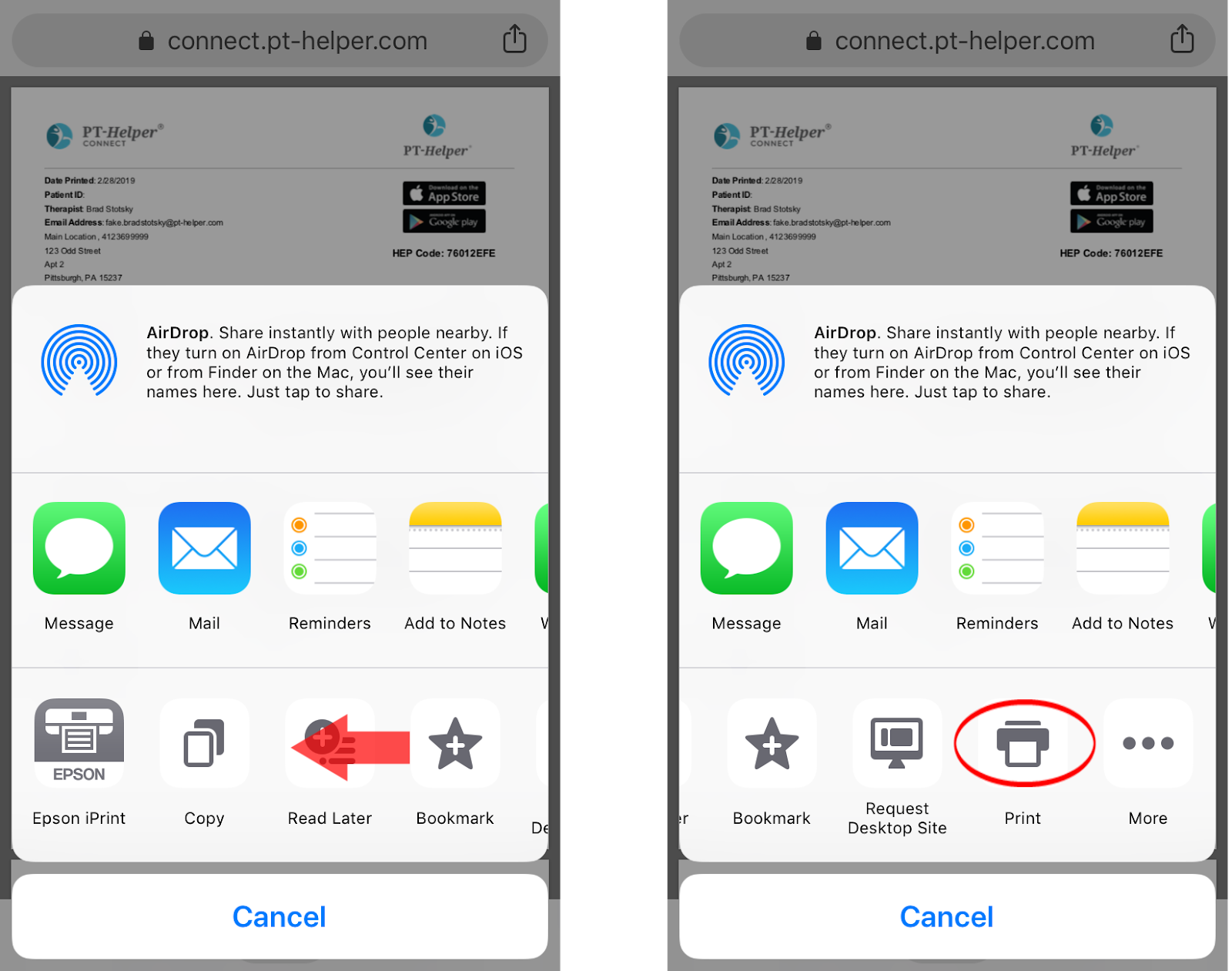
- Select the
symbol at the top right of the screen
- Press ‘Printer’ to find the EPSON WF-100 Series if it is not currently displayed
- Select the Options ‘Color’ to enable the option to change the print out to black and white as well as the option to change which pages are printed. Note that B&W printouts will save on the color ink.
- Press ‘Print’ at the top right of the screen to print.
Android Set Up
- Install Epson iPrint and Epson Print Enabler from the Google Play Store.
- Make sure that you are connected to the printer’s Wi-Fi network.
- Open Epson iPrint
- Press ‘Agree’ on the Software License Agreement and Privacy Statement page
- Press ‘OK’ on About Usage Survey page
- Make sure WF-100 printer is found on the top of the page
Android Printing from Chrome Browser
Open your preferred browser. In this example, we use Chrome.
- Login to your PT-Helper CONNECT account
- Select or create a patient profile
- Select or create a patient treatment plan. Make sure that you are on the Exercise Details page.
- Select the Print button to create a PDF file in a new tab on Chrome
- Select ‘Print’ in the pull-down menu. Make sure the Epson WF-100 Series is displayed at the top of screen.
- Select ‘Color’ to change the print out to black and white. Note that B&W printouts will save on the color ink.
Thursday, February 28, 2019
PT-Helper's February Blog Posts for Physical Therapists
Hip or Knee Osteoarthritis (OA) Exercises
Published on Feb. 21, 2019
The GLA:D™ Osteoarthritis Exercise Program for knee and hip is presented. Clinicians can search the exercise library in our exercise prescription web-service CONNECT with “GLA:D” to quickly and easily view and select these exercises.
Reminder: Please consult your physician or physical therapist before engaging in any physical activity and stop if you experience pain or discomfort.
Diversity In PT-Helper’s Exercise Illustrations
Published on Feb. 14, 2019
PT-Helper expands our diversity representation in our exercise illustrations to provide a more inclusive environment for physical therapy patients.
The Importance of Nutrition On Injury Recovery
Published on Feb. 7, 2019
By guest blogger Paul Fisher
Paul presents nutritional guidance on maintaining a healthy lifestyle after an injury and following a rehabilitation program. Consuming foods that reduce inflammation, managing caloric intake, and managing macronutrients while injured are discussed.
Thursday, February 21, 2019
Hip or Knee Osteoarthritis (OA) Exercises
While at the 2019 American Physical Therapy Association’s (APTA) Combined Sections Meeting (CSM) conference, I had the opportunity to attend Urban Poling’s ACTIVATOR® Course where founder Mandy Shintani presented the foundations and different techniques of using their poles as a replacement to canes, walkers and crutches. I primarily wanted to attend the course to see how physical therapists responded to the use of the poles as PT-Helper recently added exercises using the ACTIVATOR poles into our library.
The therapists in attendance were very interested and attentive despite having spent a full day at CSM. During one of the discussions, Mandy mentioned that Canada had implemented the GLA:D™ Osteoarthritis Exercise Program where 1 in 4 people in Canada have osteoarthritis. As a non-clinician and ex-patient, I am always interested in learning about new exercise programs that we can add to the PT-Helper library to enable therapists to prescribe exercises to their patients.
Further research revealed that the GLA:D program (Good Life with Arthritis: Denmark) is an educational and exercise program developed in Denmark which showed up to 30% pain relief for people with hip or knee osteoarthritis symptoms. We were able to identify some exercises within the GLA:D program at the TREK Translate Research Evidence and Knowledge website.
Many of the exercises were already available within the PT-Helper exercise library. We have added a few exercises such as Knee Extension Resisted and Step-Down/Step-Up (Forward). We have also added the metatags “GLA:D” to all the related exercises so that clinicians can search the exercise library in our exercise prescription web-service CONNECT with “GLA:D” to quickly and easily view and select these exercises.
Exercises with PT-Helper that are metataged with GLA:D are:
Reminder: Please consult your physician or physical therapist before engaging in any physical activity and stop if you experience pain or discomfort.
You can find these exercises (and many more) in the Geriatric category in the PT-Helper mobile app to add to your Favorites which allows you to customize each exercise’s repetitions, sets, and hold time. You can also set up 3 daily reminders to notify you when to do your exercises.
Start your Free 30-day Trial of the PT-Helper CONNECT service for physical therapists and other wellness professional, to prescribe Home Exercise Programs.
Download the PT-Helper mobile app for patients and exercise enthusiasts to create your exercise program.
The therapists in attendance were very interested and attentive despite having spent a full day at CSM. During one of the discussions, Mandy mentioned that Canada had implemented the GLA:D™ Osteoarthritis Exercise Program where 1 in 4 people in Canada have osteoarthritis. As a non-clinician and ex-patient, I am always interested in learning about new exercise programs that we can add to the PT-Helper library to enable therapists to prescribe exercises to their patients.
Further research revealed that the GLA:D program (Good Life with Arthritis: Denmark) is an educational and exercise program developed in Denmark which showed up to 30% pain relief for people with hip or knee osteoarthritis symptoms. We were able to identify some exercises within the GLA:D program at the TREK Translate Research Evidence and Knowledge website.
Many of the exercises were already available within the PT-Helper exercise library. We have added a few exercises such as Knee Extension Resisted and Step-Down/Step-Up (Forward). We have also added the metatags “GLA:D” to all the related exercises so that clinicians can search the exercise library in our exercise prescription web-service CONNECT with “GLA:D” to quickly and easily view and select these exercises.
Exercises with PT-Helper that are metataged with GLA:D are:
- Bridge on Ball - Lie on your back with both feet on top of an exercise ball. Engage your abdominal muscle then raise your hips up trying to make a straight line from shoulders to feet. Hold. Slowly lower your hips back to the ground. Repeat.
- Chair Rise - Sit on the edge of a chair with both feet flat on the floor. Stand upright without using your hands. Return back to the seated position using the "nose over toes" posture, leaning forward so that your nose is over your toes while slowly bending your knees.
- Chair Rise With Support - Sit on a chair which is not too low. Place the feet behind the knees. Lean forward over your knees. Push off with one or both hands as recommended by your therapist to stand up. Sit back down. Repeat.
- Hip Abduction – Resisted - Secure the band to a stationary point, place both feet inside the band. Keep both thighs tight. Facing perpendicular to the attached point of the band, kick out to the side keeping toes straight ahead and both legs straight, then return to starting point.
- Hip Adduction – Resisted - Secure the band to a stationary point, place inside foot in the band. Keep both thighs tight. Step far enough away to create resistance, allow band to take inside leg in, then pull in towards your standing leg. Keep both legs straight and try to keep moving foot off the ground.
- Knee Extension Resisted - While sitting in a chair, attach a band around the back leg of the chair and wrap the other end around your foot. Make sure that there is tension in the band while at rest. Raise your leg by straightening your knee fully while contracting your quad. Slowly lower your leg. Weights may be placed around your ankle. Repeat
- Step-Down/Step-Up - Stand on a step or stool with one leg, the other leg hanging off the end of the step or stool. Slowly bend the leg on the step, lowering the other foot to the floor. Return to the starting position by straightening your front leg.
- Step-Down/Step-Up Forward - Stand on a step or stool with both legs, facing the edge of the step or stool. Slowly bend one leg, lowering the other foot to the floor in front of you. Return to the starting position by straightening your rear leg.
Reminder: Please consult your physician or physical therapist before engaging in any physical activity and stop if you experience pain or discomfort.
You can find these exercises (and many more) in the Geriatric category in the PT-Helper mobile app to add to your Favorites which allows you to customize each exercise’s repetitions, sets, and hold time. You can also set up 3 daily reminders to notify you when to do your exercises.
Start your Free 30-day Trial of the PT-Helper CONNECT service for physical therapists and other wellness professional, to prescribe Home Exercise Programs.
Download the PT-Helper mobile app for patients and exercise enthusiasts to create your exercise program.
Thursday, February 14, 2019
Diversity In PT-Helper’s Exercise Illustrations
When I first started PT-Helper, the idea was to help all physical therapy patients complete their home exercises. Our first exercises were represented by male models as our exercises were based upon my demo videos doing my own prescribed shoulder exercises from my separated shoulder injury and broken clavicle.
Even though I was the initial model for our exercises, I will readily admit that our illustrations are not an embodiment of my physical characteristics. Our graphic artist, principal illustrator and co-founder, Andrew Kwan, took artistic liberties and created a character with strong musculature that we felt would be appropriate for a health product.
Once we created a reference model for our male character, it was simple to continue creating exercise illustrations using our available model to add additional exercises, recommended by physical therapists, to our library.
As we attended several conferences, we started receiving requests to include female representation in our exercises which resulted in creating a reference model of our female character.
During the 2019 American Physical Therapy Association’s (APTA) Combined Sections Meeting (CSM), we were approached by a therapist that asked about African-American representation in our exercises, specifically for the Pelvic Floor section. We have since created a reference model for an African-American female character and have created additional exercises within the Pelvic Floor exercise library.
We will continue to expand our exercise library based upon recommendations from physical therapists and other health professionals. If you would like us to create additional exercises for your practice, please let us know at info@pt-helper.com.
We hope that creating a diverse set of exercise illustrations will help motivate all physical therapy patients to complete their home exercises and improve their outcomes.
Thank you,
Fred & Joan
Start your Free 30-day Trial of the PT-Helper CONNECT service for physical therapists and other wellness professional, to prescribe Home Exercise Programs.
Download the PT-Helper mobile app for patients and exercise enthusiasts to create your exercise program.
Thursday, February 7, 2019
The Importance of Nutrition On Injury Recovery
By guest blogger Paul Fisher
Injuries are a part of everyday life, even more so for athletes and people with high levels of physical activity. Patients rely on Physical Therapists to help them make a full recovery and resume their job, sport, or day to day activities. Physical Therapists work hard to design a comprehensive rehabilitation plan that will produce optimal results for the patient. Incorporating nutrition into the plan is one way to add value to the patient and optimize the plan for their success.
A well-balanced diet is not only important for living a healthy, active lifestyle, it can play a big role in supporting and even increasing recovery time from injury. The most important thing to consider about nutrition as it relates to injury recovery is to avoid nutrient deficiencies. Maintaining energy, protein intake, and other nutrients can make a difference in the patient’s progress. Incorporating some key dietary factors into the rehab plan can not only support a patient through the immobilization and rehabilitation phases, but also help them maintain long-term healthy practices.
If your patient already follows a nutrition plan, some of the points in the article may only require small changes or reinforcement. Even for those who do not have a nutrition plan, many of these considerations are very straight-forward and can be included in their diet without much effort. Consuming whole foods or products with ingredients made from whole foods is a good starting point. Understanding current nutrition habits of your patient can make it easier to scale calorie and macronutrient consumption as the course of rehabilitation evolves.
Injury and Immobilization Phase
Early in the recovery process, when a patient is injured or immobilized, reducing inflammation, managing caloric intake, and maintaining protein are key factors to aid recovery.
- Consume foods that reduce inflammation
- Healthy fats, like Omega 3 fatty acids, play a role in muscle building, recovery, and decreasing inflammation
- Antioxidants and adaptogens found in plants, roots, and fruits help the body handle oxidative stress and support the adrenal system, which can assist recovery and help maintain muscle mass
- Often, when an injury occurs, physical activity decreases. Managing caloric intake is critical to support this stage of the injury
- Less severe injuries may allow for some physical activity, but it may still be less than normal. Therefore, fewer calories are needed to avoid weight gain
- Include plenty of fruits and vegetables.
- Severe injuries requiring surgery or crutches will require more calories to allow the body to maintain strength through healing
- Managing macronutrients during the early phase of an injury can also assist with recovery, managing weight gain, and maintaining muscle.
- Protein helps maintain and repair muscles
- Muscle loss can occur when immobilized or activity is reduced
- RDA is .8 grams of protein per kg body weight
- Athletes may require more protein to maintain muscle
- Protein pacing or consuming a consistent amount of protein (20-40g) with each meal
- Consuming protein before bed can also support muscle growth and recovery overnight
- Go smart with the carbohydrates
- Carbohydrates are still required, but less may be needed to avoid weight gain during a low activity phases
- Include complex carbs and whole grains as opposed to refined sugars and sweets
- Healthy fats are important for muscle building and reduced inflammation
- Swap out the friend, greasy, and saturated fats for healthier fats from fish, plants (avocado, coconuts), and nuts.
The same basic principles apply during rehabilitation, but increased activity and energy utilization can change the patient’s nutritional needs. Changing the caloric intake and nutrient balance is important to ensure the patient is properly fueled for performance and recovery.
- Increase calories to match the increase in physical activity
- Additional calories may come from adding in more carbohydrates, especially for athletes that reduced carbohydrates after the injury
- Maintaining or even increasing protein intake to support muscle recovery and growth
- Healthy fats continue to play a role during the rehabilitation process, as they will help with the healing process
- Additional nutrients to consider during recovery for patients
- Protein (20 – 40 g per meal) containing leucine is recommended for recovery
- Calcium and vitamin D help recovery for fractures and strengthen bones
- Zinc, vitamin C, and vitamin A can assist with wound healing
- Creatine can help build healthy muscles
- General health recommendations for healthy lifestyle and recovery from injury
- Maintain a healthy body fat %
- Proper hydration – drink at least half your body weight in ounce of water
- Getting ample sleep is important in the recovery process. The National Sleep Foundation recommends between 7-9 hour of sleep each night for adults
Helping the patient understand that nutrition does play a role in helping your body recover is the first step. Our bodies are amazing at healing themselves, if nourished properly. Food really is our best medicine. Working with a wellness coordinator or nutrition program are options for Physical Therapists to consider if they prefer to keep their focus on the therapy part of the plan. Adding additional nutritional services for the patient can differentiate your practice and provide better service to your patient.
About Paul Fisher
Paul is a health and wellness consultant who is passionate about helping people feel their best from the inside out. He believes that food can be the best medicine and help set the foundation for living our best lives. Paul specializes in helping people with weight-loss, stress reduction, reduced inflammation, and athletic performance. He works in-person and virtual with individual clients as well as with businesses and health practices.
Paul became interested in health and nutrition when his father, a runner for over 40 years, had heart disease and needed open heart surgery. It was that moment when he realized that food and nutrition so important to living a long, healthy life. His father is doing great now and has adapted many healthy dietary changes to help keep him as active as ever.
Paul lives in Cranberry Twp, PA with his wife and daughter.
You can contact Paul on social media @pfisher26 on Facebook, Instagram, and LinkedIn
Subscribe to:
Posts (Atom)