Thursday, July 11, 2019

New Lower Back Exercises on PT-Helper

If you are a therapist, you can create your own exercises within PT-Helper CONNECT or you can contact us at info@pt-helper.com to let us know which exercises you would like us to add.

We continue to add new exercises to PT-Helper as part of our on-going efforts to improve its capabilities for both therapists and patients. In today’s blog, we focus on 3 new Lower Back exercises that are available in both PT-Helper CONNECT and the PT-Helper mobile app.

  • Vertebral Roll: Lie on your back on top of a foam roller. Bend your knees with your feet aligned with your hips. Raise one arm up into the air while simultaneously lifting the opposite leg off the floor. Tighten your abdominal muscles. Extend your raised leg, straightening the knee so that your leg is parallel to the floor. Simultaneously drop the opposite arm above your head so that the arm is parallel to the floor. Make sure to keep your back flat on the roller. Return to the starting position. Repeat 

  • Lateral Hamstring Stretch with Strap: Lie on your back with a strap wrapped around your involved foot. Bend your involved leg while keeping your other leg straight. Raise your involved leg up into the air. Keeping your pelvis on the floor, pull on the strap with your opposite hand to stretch the outside hamstring. Hold. Return your leg to its starting position. Repeat. 

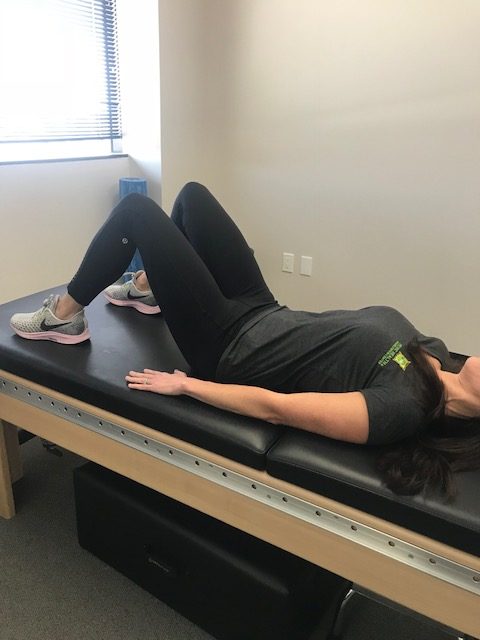
  • Transversus Activation: Lie on your back with your knees bent and hands resting on your stomach above your hips or by your side. Tighten your abdominal muscles, pulling your navel towards your spine and up. Keeping your abdominal muscles tight, slowly lift one leg up to 90 degrees. Keeping your abdominal muscles tight, slowly lift your other leg up to 90 degrees. Hold. Return your legs back down to the floor one at a time. Do not hold your breath. Repeat starting with the other leg.
 
You can find these exercises (and many more) in the Lower Back category in the PT-Helper mobile app to add to your Favorites which allows you to customize each exercise’s repetitions, sets, and hold time. You can also set up 3 daily reminders to notify you when to do your exercises.

Reminder: Please consult your physician or physical therapist before engaging in any physical activity and stop if you experience pain or discomfort.

Start your Free 30-day Trial of the PT-Helper CONNECT service for physical therapists and other wellness professional, to prescribe Home Exercise Programs.

Download the PT-Helper mobile app for patients and exercise enthusiasts to create your exercise program.


Thursday, June 27, 2019

PT-Helper’s June Blog Posts for Physical Therapists

Sacroiliac Joint Pain Exercises and Stretches
Published on June 20, 2019
Research indicates that about 80% of the population will experience low back pain at some point in their lifetime. This blog presents 4 exercises and stretches to strengthen and stabilize the sacroiliac joint of the lower back.

5 Reasons Hands-on PT May Supplement or Replace Pain Meds
by guest blogger Brian Scherff, PT
Published on June 6, 2019
Brian identifies 5 reasons when physical therapy trumps opioid use. “If preventing long-term opioid use is a treatment goal, the research all supports that those receiving early Physical Therapy had fewer long-term opioid use rates.”

Thursday, June 20, 2019

Sacroiliac Joint Pain Exercises and Stretches

One of the most common causes of disability is low back pain with about 80% of the population experiencing low back pain in their lifetime. I too have experienced excruciating lower back pain which may have been caused by one of my many falls off the bicycle, sitting in front of a computer all day, or bad posture while watching TV on the couch. I was diagnosed with a mis-aligned sacrum and adjustments helped alleviate my pain.

In order to prevent a re-occurrence of my back pain, I wear a sacroiliac support belt while sitting in front of my computer and on long driving trips. I also do stretches and exercises to strengthen my sacroiliac joint.

Listed below are just a few exercises and stretches that I do daily and are also recommended by SPINE-health. These exercises are part of the PT-Helper’s exercise library.

Reminder: Please consult your physician or physical therapist before engaging in any physical activity and stop if you experience pain or discomfort.


  • Hands and Knees Balance (Bird Dog): Position yourself on your hands and knees, with arms shoulder width apart and knees slightly apart. Tighten your abdominals, raise one arm and opposite leg slowly until they are horizontal. Keep hips even and back flat. Hold. Return to starting position and relax. Repeat with opposite arm and leg.


  • Bridging: Lie on your back with both knees bent, feet flat on the floor and arms at your side. Engage your abdominal muscle then raise your hips up trying to make a straight line from shoulders to knees. Hold then lower down slowly keeping abdominals tight.


  • Seated Hamstring Stretch: Sit on the edge of a chair, one leg bent and the other leg straight with toes pointing up. Lean over the straight leg. Gently let gravity pull you forward and stretch the hamstring on the straight leg.


  • Single Knee to Chest: Lie on your back with both knees bent. Slowly bring one knee up, grab with hands and gently pull towards your chest. Hands can be under or over the front of your knee. You will feel a stretch in your lower back and buttocks.

Thursday, June 6, 2019

5 Reasons Hands-on PT May Supplement or Replace Pain Meds

by guest blogger Brian Scherff, PT


The American Physical Therapy Association (APTA) is undertaking an anti-opioids campaign touting the benefits of Physical Therapy (PT) over highly addictive pain meds. The campaign is getting some negative buzz from opioid users but they, as well as others in the field, have some valid, statistical research on how PT can work better than pain meds. As with most issues, there are two sides to all opinions. This is how Excellence in Rehabilitation feels.

I’m not taking the stand that opioids should NEVER be used but the CDC released opioid prescription guidelines in March 2016 recognizing that prescription opioids are appropriate in certain cases, including cancer treatment, palliative care, and end-of-life care, and also in certain acute care situations—if—and it’s a big if—properly dosed.

So when could PT trump opioid use; or at the very least help reduce it?

  • When the risk of the opioid outweighs the benefit. Using opioids for pain relief can include some horrible side effects, including depression, overdose, and addiction. And stopping the opioids can cause severe withdrawal symptoms. Consider whether long-term benefits outweigh the risks. The CDC states, “Even in cases when evidence on the long-term benefits of non-opioid therapies is limited, ‘risks are much lower’ with non-opioid treatment plans.”
  • When the pain becomes chronic (defined as lasting beyond 90 days). At that point, opioids may only be masking the pain where non-opioid therapies “are preferred” for chronic pain according to the CDC. Again, weighing benefit to risks, PT administered by a clinician could lead to greater benefits in both pain and function, and result in lowered risk to the patient.
  • When mental health issues exist. A study supported by the National Institute of Drug Abuse of the National Institutes of Health showed a link between mental health, opioid use, and opioid risk factors citing those with higher negative affect (a constellation of anxiety, depression, and catastrophizing cognitive style) were at a higher risk of opioid misuse. Subjects in the high risk group also tended to have a more frequent history of substance abuse and every subject in the high group had a psychiatric diagnosis of some type of an affective disorder. Identifying patients with affective disorders could be key in implementing PT to replace opioid use.
  • When a reduction in pain is possible without pain medication. The APTA shows a JAMA Network Open article that reports early Physical Therapy was associated with a reduced risk of any opioid use in all 4 conditions tested: a 16% drop for knee pain patients, a 15% reduction for those with shoulder pain, 8% for neck pain, and 7% for low back pain. Among patients who were prescribed (and used) opioids, early Physical Therapy seemed to have an association with fewer pills taken for 3 of the 4 conditions.
  • To follow expert recommendations. The CDC recommends non-opioid treatment as a primary method to address chronic pain, including low back pain. Physical therapy is considered a safe alternative to manage chronic low back pain.

One review of the research from Oregon Health and Science University found that rates of opioid prescribing in the US and Canada are two to three times higher than in most European countries. “Opioids do not seem to expedite return to work in injured workers or improve functional outcomes of acute back pain in primary care.” And for chronic back pain, there is “scant evidence of efficacy…Opioids seem to have short-term analgesic efficacy for chronic back pain, but benefits for function are less clear.”

According to the APTA, part of the problem with patients seeking PT is the barrier to entry. They say “current policies create barriers for patients seeking physical therapist treatment. In most cases, it’s easier and less expensive for physicians to prescribe opioids and for patients to receive opioids.” Insurance providers may require a primary care provider referral, which, while beneficial, may delay physical therapy. And the Duke Clinical Research Institute says high co-payments can also be a barrier—often, the co-payment for a one-month opioid prescription is less than the co-payment for a single session with a chiropractor or physical therapist.

Based on this research and my 20+ years as a Physical Therapist and Instructor in the field, for me, the biggest takeaway is that early Physical Therapy may be an option for several musculoskeletal conditions. If preventing long-term opioid use is a treatment goal, the research all supports that those receiving early Physical Therapy had fewer long-term opioid use rates.

If knowledge is power, that’s important information for Physical Therapists to have in their treatment toolbox.

About Brian Scherff, PT

Brian has spent most of his PT career in outpatient therapy and home care. He has specialized in spine pain, vestibular treatment and balance. Brian is currently preparing to launch a new type of exercise table, the Multiple Applications Table (MAT). The MAT table advantage is that it offers both rehabilitation treatment and multi-function exercise capabilities in a single table at a remarkably small footprint.


Friday, May 31, 2019

PT-Helper’s May Blog Posts for Physical Therapists

Easy Mobile Access for Home Health Providers
Published on May 23, 2019
We have listened to home health providers and have made improvements to our PT-Helper CONNECT web-based exercise prescription service. It is now even simpler to use on both smartphones and tablets.  You can easily create home exercise programs on your mobile devices.


5 Easy Exercises to Help Ease Pregnancy Aches and Pains
by guest blogger Sigourney Cross, DPT  at Pelvic Health and Rehabilitation Center
Published on May 16, 2019
Pelvic and low back pain during pregnancy affects up to two-thirds of women and can start anytime from the first trimester to months after giving birth. Sigourney provides exercises can ease the aches and pains of pregnancy and prepare your body for the rigors of labor.


New Features on PT-Helper Mobile App
Published on May 9, 2019
We continue to work on improvements in our PT-Helper mobile app to make it even easier to use and more useful to patients and health professionals. We share 2 new features available on the mobile app to help patients complete their home exercise program.

Thursday, May 23, 2019

Easy Mobile Access for Home Health Providers

We have listened to home health providers and have made improvements to our PT-Helper CONNECT web-based exercise prescription service. It is now even simpler to use on both smartphones and tablets.  You can easily create home exercise programs on your mobile devices.

Let us show you how easy it is. While creating a new patient in CONNECT, you only need to provide the First and Last Name of your patient. If you would like to email them a copy of their home exercise program, simply include an email address in their profile. The screenshots below are all from my smartphone.


Once you have created a patient profile, just enter an injury and then add exercises to their treatment plan for that injury. In the example below, Princess Leia has specified Low Back Pain for her patient, Jabba Hutt.

While adding exercises into the treatment plan, you can select them within categories to help quickly identify the ones you want and then customize sets, reps, etc. You can also create your own Templates or Protocols in CONNECT to further organize your preferred exercises. In the example below, the exercise Dead Bug was selected for Jabba Hutt.


Once a treatment plan is developed, CONNECT will automatically create a unique HEP code.  If your patient has the PT-Helper mobile app, you can simply give them the code and the exercises you selected for them will appear instantly. You would not need to print the exercises!


If you do need to print the home exercise program, we have created a blog “Printing for the Home-Care Physical Therapist” to walk you through the process of setting up and printing to a small portable printer.

The PT-Helper CONNECT always has a 30 day FREE Trial period.  Sign on and try it out!  Credit Card is not required.  Let us know what you think. We would love to get your feedback!

Thursday, May 16, 2019

5 Easy Exercises to Help Ease Pregnancy Aches and Pains

by guest blogger Sigourney Cross, DPT  at Pelvic Health and Rehabilitation Center


Pelvic and low back pain during pregnancy affects up to two-thirds of women and can start anytime from the first trimester to months after giving birth.1 This is due to a couple of reasons. First, there is a change in your hormone levels. Increased levels of the hormones relaxin, estrogen and progesterone begin to loosen the ligaments that hold your pelvis together in order to prepare you for childbirth. When these ligaments get stretched too far, it can cause pain. Another cause for pain is your rapid weight gain. As your belly grows during pregnancy your center of gravity is shifted forward. This causes an increased lordosis or pronounced curvature of your low back. This places excessive strain on your lumbar spine as well as the muscles and ligaments around the pelvis. When pregnant you may also spend more time resting and sitting which can lead to muscular imbalances, weakness and trigger points.

The pain location and type women experience varies. Pain can be experienced in the lower back, top of your hip bones, back or front of your hips, groin, over your buttocks, down the back of the legs, over the pubic bone and into the vulva. The nature of the pain can be anywhere from a mild to severe achiness, stinging or burning sensation, or sharp and stabbing sensation. Thankfully, there are multiple measures women can take to alleviate their pain including pregnancy support garments such as leggings, belts, bands or girdles, sleep pillows for optimal posture and alignment, acupuncture, pregnancy approved pain relievers, prenatal massage, prenatal pelvic floor physical therapy, and of course exercise! Women with uncomplicated pregnancies are encouraged to engage in aerobic, stretching and strengthening exercises with the necessary modifications to ensure safety for both mom and baby. According to The American College of Obstetricians and Gynecologist an exercise program during pregnancy should include moderate intensity exercise for at least 20-30 minutes per day on most days of the week.

The following exercises can ease the aches and pains of pregnancy and prepare your body for the rigors of labor.

1. Cat-Cow (Mad Cat/Saggy Nag): Being on all fours, keeping the top of your feet flat on the ground. Your hips should be aligned directly over your knees and your shoulders over your wrists. To get into the cow inhale while letting your back arch and belly drop. Keep shoulders rolled back while looking slightly up. As you exhale, round your upper back and shoulders while looking down at your belly. This is cat. Continue moving into your cow on your inhales and cat on your exhales. This exercise helps increase spine mobility and circulation and gently strengthens your low back helping ease hip, pelvic, low back and round ligament pain.


2. Bridges: Begin by lying on your back with your arms at your sides. Bend your knees so that your heels are close to your butt. Next, press your heels into the floor and lift your hips up until you form a bridge with your body. As you are lifting your hips, remember to squeeze your butt muscles, hold this pose for a second at the top before slowly lowering your body back down. This exercise can help ease back pain by strengthening your glutes (butt muscles), low back and abdominals as well as providing a gentle stretch to your hip flexors.


3. Child’s Pose: Start out on all fours with your ankles together and knees wide apart. Next, slowly sit back bringing your butt down to your ankles as low as you can go. Then stretch your arms out in front of you on the floor. Allow your weight to sink down and back to slightly round. Hold this position for a few minutes, while breathing deeply. This is a great stretch for low back and hip pain. It helps elongate your spine and take away tension from the added weight you are now carrying, by relieving pressure on the surrounding nerves. This is also a great exercise to relax your pelvic floor muscles!


4. Seated Piriformis Stretch: Sit on a chair with your feet flat on the ground. Cross one foot over the other knee making the number 4. Lean forward keeping your back flat until you feel a stretch in your low back and buttocks of your top leg. Hold this position for 30-90 seconds and repeat on the other side. The piriformis muscle is a small muscle deep in the glutes that can spasm during pregnancy. This can often cause back and leg pain because it extends across the sciatic nerve. Gentle stretching of this muscle can help decrease tightness and pain.


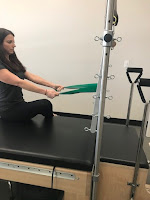
5. Seated Row: You can use either free weights or resistance bands. Begin in a seated position with your back upright. Tighten your abdominal muscles and have your arms extended forward in front of you. Slowly pull the weights or resistance band all the way towards your stomach, keeping your elbows down at your sides while pulling your shoulder blades together. Hold this position for one second before slowly returning to your starting position. Repeat. Remember to keep your shoulders down and back during this exercise. This is a great exercise to help improve your posture, relieve back pain and strengthen your back muscles and as they become weaker with your growing belly.

Other exercises that have been proven to be beneficial in preventing and/or reducing pelvic pain include walking, swimming and prenatal yoga. Walking is the number one option for many women as its low-impact, a great way to maintain and improve your cardiovascular fitness, easy to make a part of your daily routine and free! Swimming is another great way to get exercise, especially later in your pregnancy as the buoyancy of the water takes the strain off your joints and ligaments. Finally prenatal yoga is a great way to keep your core strength, flexibility and balance in check. It’s important to remember to maintain a mild to moderate intensity while exercising, to take frequent breaks, practice good form and posture, and avoid positions or movements that increase pain or discomfort. Whether you’re a seasoned athlete or a beginner, be sure to get clearance from your doctor before starting an exercise program while pregnant. Women with higher risk pregnancies may have more restrictions.

If these exercises don’t do the trick I recommend getting a physical therapy evaluation for a more focused program that fits your needs.

References:
  1. Physical activity and exercise during pregnancy and the postpartum period. Committee Opinion No. 650. American College of Obstetricians and Gynecologists. Obstet Gynecol 2015;126:e135–42.
  2. Prendergast, SA. Pelvic floor physical therapy for vulvodynia: a clinician’s guide. (2017). Obstetrics and Gynecology Clinics of North America, 44(3), 509-522.
  3. Babycenter.com


About Sigourney Cross, DPT

Sigourney grew up just outside Minneapolis, MN. She graduated from the University of Minnesota with a Bachelor’s degree in Journalism followed by her Doctor of Physical Therapy degree from Hampton University. Having worked across the country and being licensed in six states, she brings a wealth of experience and knowledge to Pelvic Health and Rehabilitation Center (PHRC). Sigourney looks forward to sharing her expertise with patients to help them gain a better quality of life. When not working, she enjoys playing the piano, dancing, trying new restaurants and spending time with family and friends.