Tuesday, June 26, 2018

Why Do Patients Not Know How To Do Their Exercises


We frequently hear stories from physical therapists and physical therapist assistants that their patients can’t seem to remember how to do their home exercises. The typical story goes like this:

Patient comes into the clinic.
PT/PTA,  “Did you do your home exercises this past week?
Patient, “Yes I did.
PT/PTA, “Great. Let’s get you started with this exercise.
Patient stands around looking a little lost.
PT/PTA, “Is there something wrong?
Patient: “How do I do this exercise again?

If you’ve experienced this exchange with your patients, you’re not alone. What were your thoughts after this exchange?

Perhaps you would think, 
“Clearly he/she hasn’t been doing their exercises!”

One other thing therapists might think is,
“If I can do a better job of teaching him/her how to do this exercise, then they’ll remember how to do this exercise.”

However, as an ex-patient, I can honestly say that I was able to remember how to do all of my exercises as I left the clinic. I believe that the challenge is when the patient never or doesn't regularly do any of their exercises and then shows up at the clinic the following week. After days without doing their exercises, it is unlikely that the patient is going to remember how to do an exercise even if they had it memorized the previous week.

Since learning how to do an exercise is not the issue, then getting your patients to do their exercises is! 

One of my good friends recently had back surgery 3 months ago. Even though she’s a nurse and fully understands the benefits of doing her home exercises, she confessed to me that she often doesn’t do it as she gets busy and can’t allocate the time to do all of her exercises. She said something always gets in the way. 

I wonder if she’s ever had this discussion with her therapist. I know that she’s made significant progress since the surgery but after standing at a corner of a bike race for a few hours directing riders and traffic, she started to exhibit significant limping and was clearly in pain. 

How can a therapist overcome the excuse of “no time”. Would breaking up her exercise program into multiple shorter sessions allow her the opportunity to complete at least some of her exercises instead of doing none? Maybe reducing the number of exercises in her program would be enough to overcome her no time excuse.

Each patient is different and may also have different behaviors depending upon how far away their injury or surgery occurred. Keep an open communication channel with your patient to stay on top of how well they are completing their home exercises.

… and if they tell you they’ve been doing their home exercises, they just might not be telling you the truth…

Start your Free 30-day Trial of the PT-Helper CONNECT tool for physical therapists and other therapy providers, so you may create and prescribe a Home Exercise Programs. Share the HEP program with your patients using the PT-Helper mobile app.


Photo by Jon Flobrant on Unsplash

Tuesday, June 12, 2018

Physical Therapy Exercises for Plantar Fasciitis

Plantar Fasciitis is a common cause of heel pain and can cause pain at the bottom of the foot while walking. Approximately 2 million Americans are treated for plantar fasciitis every year. It is particularly common injury for runners and people who stand for long periods of time.

Fortunately, plantar fasciitis can be treated by physical therapy treatment, including icing, manual manipulation, and stretching.

The Cleveland Clinic also suggests other treatments such as:

  • Heel gel pads
  • Orthotic arch support
  • Night splints
  • Walking cast
According to the American Academy of Orthopaedic Surgeons, “more than 90% of patients with plantar fasciitis will improve within 10 months of starting simple treatment methods.” Recovery from plantar fasciitis is not a quick process and often includes activity modification or rest to reduce the activities that make the pain worse.

The AAOS recommends doing calf stretches and the plantar facia stretch:
  • Soleus Stretching - Stand in front of a wall with feet staggered, one in front of the other. Lean towards the wall, bend back knee but keep back leg’s heel to the floor. Feel gentle stretch in back calf and Achilles area. Make sure back foot is facing straight ahead, not turned out.
  • Standing Gastroc Stretch - Stand in front of a wall with one foot in front of the other, keep the back leg straight. Lean towards wall while keeping back heel down, feel gentle stretch in calf of back leg. Make sure back foot is facing straight ahead, not turned out.
  • Plantar Fascia Stretch - While seated, cross your foot over the knee of your other leg. Grasp the toes of your foot and slowly pull them toward your shin in a controlled fashion. Place your other hand along the plantar fascia. The fascia should feel like a tight band along the bottom of your foot when stretched. Hold. Slowly return your toes to their starting position. Repeat. 


Athletico Physical Therapy recommends additional exercises for plantar fasciitis.
  • Towel Calf Stretch - Sit with knee straight and towel looped around the ball of one foot. Gently pull on the towel until a stretch is felt in the calf. You can also sit in a chair with leg straight, heel on the ground
  • Tennis Ball Exercise 1 & 2 - While sitting, place a tennis ball under your foot. GENTLY press into tennis ball then move your foot forwards and backwards so that the ball moves down the middle of your foot from heel to toe. Then roll the ball side to side under the ball of your foot. May be tender but should not cause pain
You can find the above exercises in the Ankle and Foot category in the PT-Helper mobile app to add to your Favorites which allows you to customize each exercise’s repetitions, sets, and hold time.


Reminder: Please consult your physician before engaging in any physical activity and stop if you experience pain or discomfort.


Start your Free 30-day Trial of the PT-Helper CONNECT tool for physical therapists and other therapy providers, so you too may create and prescribe Home Exercise Programs like the one shown above.


Tuesday, June 5, 2018

How to Save Time by Creating Exercise Protocols

A physical therapist or health professional can save time prescribing exercises to patients or clients after creating a home exercise protocol or template. The template function in PT-Helper CONNECT allows the therapist to group exercises together to be able to quickly add these exercises into a home exercise program.

To create a template, follow the steps below to easily add exercises to a template:

Select Settings in the pull-down menu found at the top right of the browser window.


This will take you to the organization’s or clinic’s configuration menu. Press the Manage Templates button at the bottom left of window.


Select Add Template to create a new template.


The Edit Template page will appear where you can provide a name for your template/protocol, add exercises to the template and assign the template to everyone within your organization or to specific individuals.


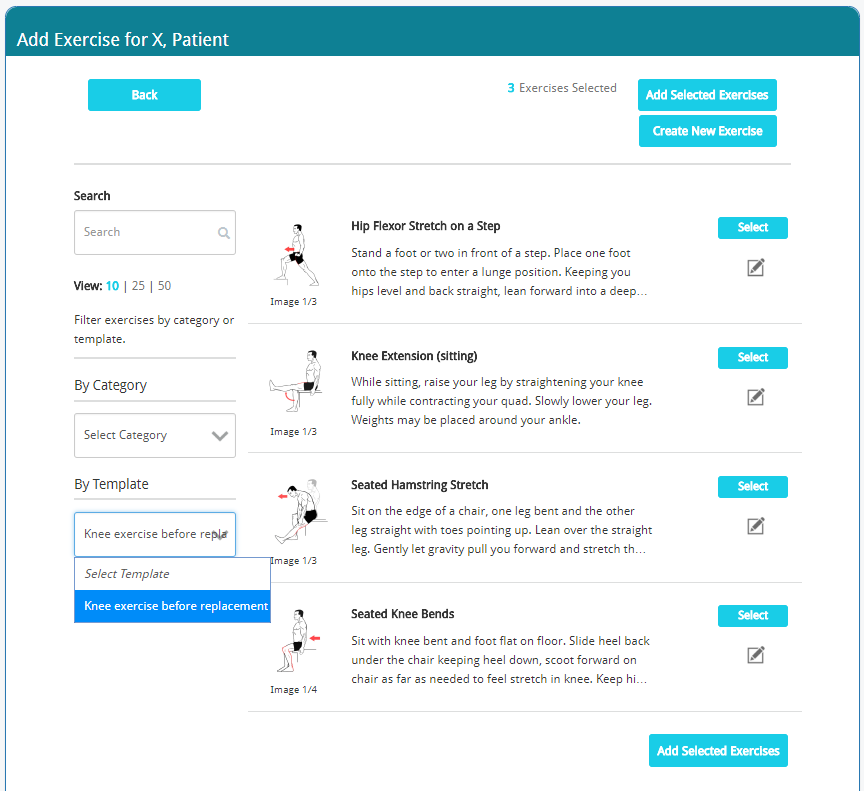
Once you’ve provided a name for your template, press Advanced Search to visually select exercises to be added into the template.


You can use the Search field or the By Category pull-down menu on the left of the screen to filter exercises to match your search. 

Once you’ve finished selecting all the exercises that you would like to add to the template, press the Add Selected Exercises button at the top or bottom of the exercise list page.


This will take you back to the Edit Template page where you can select the “Is Available To Everyone” button or select specific therapists within your organization or clinic that will have access to this template.


If you select specific therapists, this template will only appear in the Add Exercise page when the specified therapist is also selected as the treating therapist for the patient’s specific injury. 

One reason why templates may be only available for a specific therapist is the therapist may have a unique specialty such as Hand & Finger. Then Hand & Finger templates created for that therapist would not need to be seen by other therapists within the organization.  

Once a template has been created, it can be selected in the Add Exercise page of a patient’s treatment plan. 


Exercises within a template or protocol are meant to be a guide to the treating therapist to ease the process of selecting exercises for the patient. The therapist can select individual exercises within the template and change the exercise parameters to match the patient’s condition and progression. 

Start your Free 30-day Trial of the PT-Helper CONNECT tool for physical therapists and other therapy providers to create and prescribe Home Exercise Programs.


Tuesday, May 29, 2018

PT-Helper's May Blog Posts for Physical Therapists

Physical Therapy Exercises for Mommy’s Thumb/Phone Thumb
Published On May 22, 2018
“Mommy’s Thumb” or "Phone Thumb" (De Quervain's tenosynovitis) is a common repetitive use injury suffered by parents with infants or extreme smartphone users. Michael Curtis, PT recommends strengthening exercises as part of treating De Quervain's tenosynovitis. We’ve added his exercises into a Home Exercise Program (HEP) using the PT-Helper CONNECT platform and presented on the PT-Helper mobile app. 

The HEP program can synchronized with the PT-Helper mobile app with HEP code 7BBF1AC2.

Reminder: Please consult your physician before engaging in any physical activity and stop if you experience pain or discomfort. 


Published On May 15, 2018
Peer pressure, humor, camaraderie are potential avenues for you to motivate to get your patients to take meaningful action in their recovery process to get better outcomes.


Exercises to Recover From Carpal Tunnel Syndrome
Published On May 8, 2018
Carpal Tunnel Syndrome (CTS) has become a prevalent injury with the rise of computer technology. Martin Kielema at Always Fysio recommends a combination of stretching and strengthening your lower arm muscles to help you recover from CTS. We’ve added his exercises into a Home Exercise Program (HEP) using the PT-Helper CONNECT platform and presented on the PT-Helper mobile app.

The HEP program can synchronized with the PT-Helper mobile app with HEP code 520BE86B.

Reminder: Please consult your physician before engaging in any physical activity and stop if you experience pain or discomfort. 


How to Know If Your Physical Therapy Patient is Completing Their Home Exercise Program
Published On May 1, 2018
Some therapists will be able to tell immediately if their patients have not been doing their home exercises once they start manipulating them on the table. They can tell by the patient’s range of motion or by their strength improvements (or the lack of it). For others, PT-Helper CONNECT and the mobile app will keep track of when your patient completes each exercise.


Subscribe to the PT-Helper Blog here so you don’t miss these helpful compilations and BONUS, you’ll receive Our Secret Guide, unveiling the secrets your patients are keeping from you.


Tuesday, May 22, 2018

Physical therapy exercises for Mommy’s Thumb/Phone Thumb


“Mommy’s Thumb” (De Quervain's tenosynovitis) is a common injury to parents with infants due to repetitive strain use of the thumb and wrist. Repetitive actions such as lifting your baby can aggravate the symptoms of Mommy’s Thumb.

Not surprisingly, the rising use of smartphones is also causing De Quervain's tenosynovitis. U.S. smartphone penetration has exceeded 80% and mobile devices (smartphones and tablets) now represent 57% of U.S. internet traffic. As Nellie Bowles in the NY Times article “Me and My Numb Thumb: A Tale of Tech, Texts and Tendons” discovered, constant smartphone use can lead to debilitating pain in her thumb.

The Mayo Clinic identifies that people between the ages of 30 and 50 are more prone to developing De Quervain's tenosynovitis resulting in adults experiencing technology related injuries more frequently than teenagers.

Michael Curtis, PT in his blog “Mommy’s Thumb: Treating and Preventing DeQuervain’s Tenosynovitis” recommends using a splint to allow the hand’s tendons to rest and heal. He also recommends a series of strengthening exercises as part of treating De Quervain's tenosynovitis.

We’ve added his exercises into a Home Exercise Program (HEP) using the PT-Helper CONNECT platform and presented on the PT-Helper mobile app. These sample exercises can be quickly downloaded into the PT-Helper mobile app using

HEP code: 7BBF1AC2

You can also find these exercises in the Finger and Hand category in the PT-Helper mobile app to add to your Favorites which allows you to customize each exercise’s repetitions, sets, and hold time.

Reminder: Please consult your physician before engaging in any physical activity and stop if you experience pain or discomfort.


  1. Thumb Extension with Rubber Band

  2. Rest your hand vertically on a table and wrap a rubber band around your thumb, index and middle finger. Raise your thumb up against the band and hold. Slowly return your thumb back to its starting position. Repeat.


  3. Thumb Abduction with Resistance Band

  4. Rest your hand palm up on a table and wrap a rubber band around your thumb, index and middle finger. Raise your thumb up vertically against the band and hold. Slowly return your thumb back to its starting position. Repeat.


  5. Putty Squeeze

  6. Place a small amount of putty in the palm of your affected hand. Slowly squeeze the putty firmly. Reshape the putty. Repeat.


Start your Free 30-day Trial of the PT-Helper CONNECT tool for physical therapists and other therapy providers, so you too may create and prescribe Home Exercise Programs like the one shown above.


Click here to view Finger and Hand exercises currently available within the PT-Helper Exercise Library.


Tuesday, May 15, 2018

How to Lead Your Physical Therapy Patient to Care About Their Recovery

As an active individual and ex-physical therapy patient, it was quite a surprise to find out that almost 70% of physical therapy patients don’t do their home exercises. My personal expectation with physical therapy is to recover from my injury and get stronger so that I could return to doing the things that I love to do as soon as possible. That not everyone shares these same goals was quite a shock.

My first experience noticing other people don't do their exercises was over 10 years ago after my ACL surgery. I was described as an A+ patient and would religiously do my home exercises and make an intense effort to get stronger during the in-clinic exercise program. At one afternoon session, I briefly met another patient in the common workout area of the clinic. On my next clinic visit the following week, my physical therapist, Josh Lenthall at Panther Physical Therapy, mentioned to me that I made an impact on this patient who told Josh that he would be committed to do his exercises after watching me put a lot of effort into doing my exercises.

In this Psychology Today article “The Curse of Apathy: Sources and Solutions”, the author writes “through much psychological research, it’s now accepted science that you must experience feelings about something if you’re to take personally meaningful action on it.”

Maybe it was the feeling of peer pressure that motivated that individual to decide that he could do a better job in caring about his recovery. 

Adam Meakens in his Sports Physio blog believes that humor (or humour since he’s British) is an essential part of physiotherapy. Camaraderie, humor and laughter is used in the fitness world to make exercises fun and enjoyable. Can you make it fun?

One sports rehab clinic uses a bell that the patient gets to ring when they accomplish a major milestone, something like when an ACL surgery patient is able to touch his/her heel to their butt achieving full range of motion. The bell ringing is greeted with applause by the staff and other patients. Talking with their ex-patients, their excitement to be able to ring the bell as well as their support for other people's successes creates an atmosphere of hard work towards recovery.

Each individual will have their own unique drivers that will motivate them to take meaningful action. Take the time to work with your patient to understand them and get better outcomes.


Start your Free 30-day Trial of the PT-Helper CONNECT tool for physical therapists and other therapy providers to create and prescribe Home Exercise Programs.


Tuesday, May 8, 2018

Exercises to Recover From Carpal Tunnel Syndrome

Since the launch of the IBM Personal Computer in 1981, annual sales of desktop computers has exploded to peak at approximately 350 million units/year in 2010, 2011 and 2012. The massive adoption of computers has led to the belief that spending too much time working over a keyboard and mouse would cause hand pain and numbness, commonly referred to as Carpal Tunnel Syndrome (CTS).

However, a study by the Mayo Clinic indicated that there is little clinical evidence suggesting that keyboard use is a risk factor for developing CTS.

An article by Cornell University Ergonomics: Human Centered Design argues that the Mayo Clinic study was flawed as the study did not include user posture assessment. The Cornell study states that “ergonomic research shows that computer users often adopt poor wrist postures, and working in deviated postures is thought to increase the risk of injury.”

The National Safety Council (NSC) in this 2011 article “Workplace Myth” in their Safety and Health Magazine recognizes that computer keyboard use does not lead to an increase risk of CTS but may lead to other pains and strains in the wrist and hand.

To reduce the risk of some upper-extremity disorders related to computer use, the Harvard Medical School recommends:
  • When working on a keyboard or with a mouse, keep your wrists in a neutral position, rather than flexed downward or extended upward.
  • Take a break from computer work and stretch every hour. Between these breaks, take shorter breaks to rest your hands, either palms up on your lap or on a wrist rest.
  • Keep all items you may need access to – documents, telephone, keyboard, mouse and supplies – no more than 16-18 inches away to avoid awkward postures or reaching.
  • Place the computer monitor directly in front of you, at arm’s length.
  • Consider setting your keyboard on an adjustable tray that allows your forearms to remain parallel to the floor, with elbows bent at a 90-degree angle. Wrists should form a straight line with your forearms.
  • Keep your mouse close to the keyboard and at the same height. A padded wrist rest may help reduce strain.

Martin Kielema, a physical therapist at Always Fysio recommends a combination of stretching and strengthening your lower arm muscles to help you recover from CTS. We’ve added his exercises into a Home Exercise Program (HEP) using the PT-Helper CONNECT platform and presented on the PT-Helper mobile app.

These sample exercises can be quickly downloaded into the PT-Helper mobile app using

HEP code: 520BE86B

You can also find these exercises in the Wrist and Elbow category in the PT-Helper mobile app to add to your Favorites which allows you to customize each exercise’s repetitions, sets, and hold time.

Reminder: Please consult your physician before engaging in any physical activity and stop if you experience pain or discomfort.

  1. Wrist Flexor Stretch
  2. Keeping elbow straight, grasp palm side of hand and slowly bend your wrist backward until a stretch is felt on underside of forearm. Hold. Relax to starting position. Repeat 3 times while holding for 30 seconds. Do this exercise multiple times a day.

  3. Wrist Extension Resisted
  4. Place your arm resting on a table with your wrist hanging off the side of the table, your palm down, and your hand hanging down holding a weight. Bend your wrist up, pause, then slowly lower down to starting position. You may choose not to use a weight if you are not strong enough. Repeat 10 times.

  5. Wrist Flexion Resisted
  6. Place your arm resting on a table with your wrist hanging off the side of the table, your palm up, and your hand hanging down holding a weight. Bend your wrist up, pause, then slowly lower down to starting position.  You may choose not to use a weight if you are not strong enough. Repeat 10 times.


Start your Free 30-day Trial of the PT-Helper CONNECT tool for physical therapists and other therapy providers, so you too may create and prescribe Home Exercise Programs like the one shown above.


Click here to view Wrist and Elbow exercises currently available within the PT-Helper Exercise Library.